




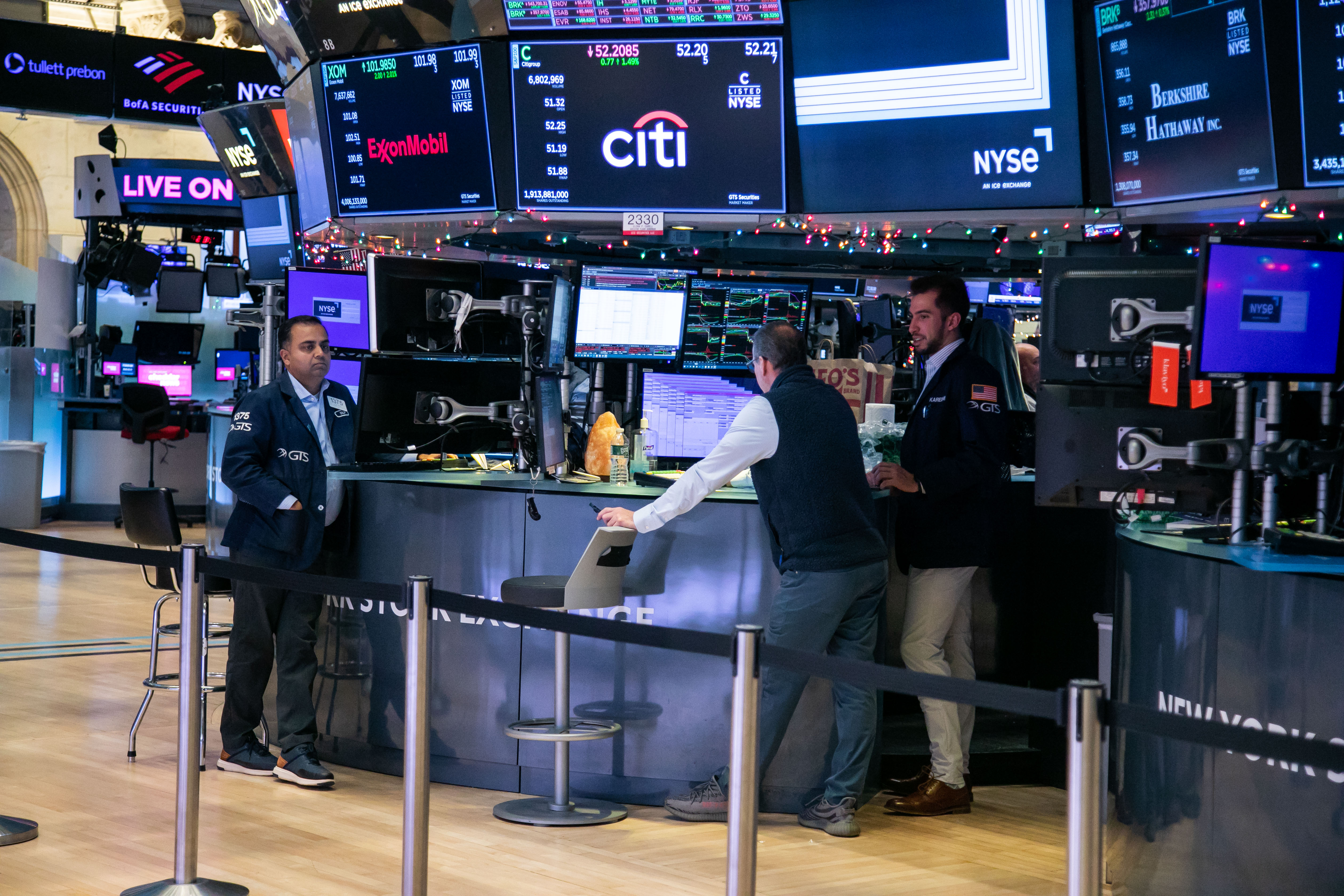
A bumpy stretch for traders across financial markets in the dog days of July and August hasn’t tempered their zest for stocks, with allocations to the asset class still robust despite a bout of recent volatility and heightened uncertainty around the economic outlook.
“Investors ‘climbed a wall of worry’ as the stock-market’s relief rally gained momentum,” said Craig Johnson at Piper Sandler. “Equities will likely consolidate ahead of Fed commentary at Jackson Hole this week.”
At Bank of America Corp., Ohsung Kwon says the Fed is unlikely to “out-dove” the market, but as long as growth is OK, equities can withstand a less-dovish Fed.
“Stocks just need a nod that growth is going to be supported,” Kwon said. “While our view is that risk is to the upside, we do not believe that Jackson Hole will spur the large equity moves that it has in the past when the Fed used it as forum to telegraph upcoming policy decisions.”
The S&P 500 rose to 5,575. Advanced Micro Devices Inc. agreed to buy server maker ZT Systems in a deal valued at $4.9 billion. Estée Lauder Cos. gave a disappointing sales forecast. Lowe’s Cos, Target Corp. and TJX Cos are among the major retail names reporting this week.
Treasury 10-year yields fell one basis point to 3.87%. The yen outperformed among Group-of-10 currencies, up about 1% ahead of key central bank events later in the week. Gold fell after hitting a record high.
“With the Jackson Hole Symposium — and Chairman Powell’s speech coming on Friday — there will be some good reasons for investors to sit on their hands this week,” said Matt Maley at Miller Tabak + Co. “Yes, quite a few retailers are reporting earnings this week. However, the data that tends to move the markets in a significant way will be absent this week.”
Equity positioning is back up to moderately overweight, a week after sliding to underweight, according to Deutsche Bank AG strategists including Parag Thatte and Binky Chadha, who said exposure remains well below the mid-July highs at the top of the historical band.
Momentum traders and a surge in corporate buybacks promise to drive a US stock rally over the next four weeks, according to Goldman Sachs Group Inc.’s trading desk.
“The pain trade for equities is higher and the bar for being bearish at the beach into a Labor Day barbecue party is high,” Goldman’s Scott Rubner, wrote in a Monday note.
Recent economic data and earnings readouts have reinvigorated confidence among JPMorgan Chase & Co. traders that US stocks can rally into the end of the year.
“While upside appears to be more muted than when we adopted this stance earlier this year, there remains material upside,” the team led by Andrew Tyler wrote.
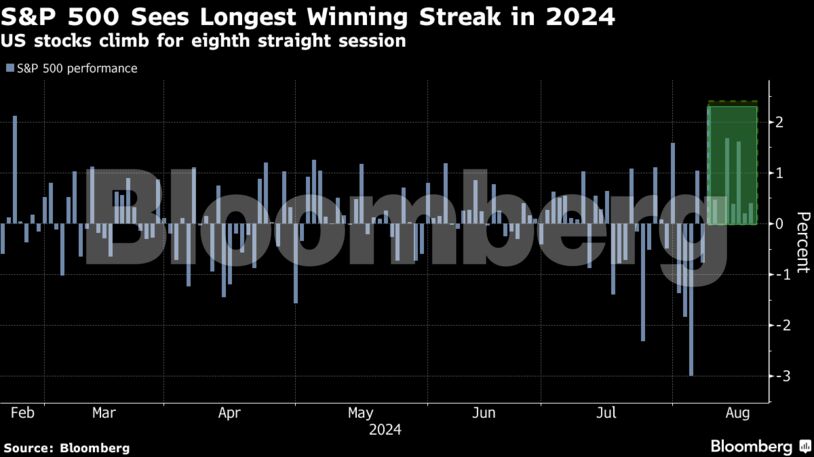
If the S&P 500 can finish higher Monday, it will stretch the current streak of daily gains to eight, the longest winning streak since last November and tied with six other periods for the longest winning streak since 2009, according to data compiled by Bespoke Investment Group.
Looking forward, even after seven straight days of gains, the S&P 500 tended to show gains going forward with median gains of 0.58% and 0.96% over the following week and month with gains just under three-quarters of the time, Bespoke said.
The trajectory for stocks is likely to be dictated by the week-to-week cadence of macroeconomic data until August’s key jobs report, due in the first week of September, according to Morgan Stanley strategists led by Michael Wilson.
“The true test for the market will be the August jobs report,” they wrote. “A strong jobs report that reverses July’s softness will provide confidence that growth risks have subsided for now. Another weak report would likely lead to growth concerns resurfacing.”
“While we do remain generally bullish, we don’t see a straight line up in the market, as the economy is slowing and there will likely be a mix of conflicting economic data points over the coming months, which is set to continue this recessionary debate,” said Greg Marcus at UBS Private Wealth Management.
Marcus believes the Fed is on track to cut interest rates by 25 basis points in September, barring a significant shock to the downside between now and then.
“Investors should be extending duration with their cash holdings in preparation for rate cuts,” he said. “It’s important to diversify within U.S. stocks and prepare for a broadening out in the market, as we believe this broadening of market participation is likely to include value stocks and small caps.”
“Three recent economic reports on inflation, jobs, and retail sales offered reasons for investors to maintain their bullish bias and allow them to conclude that the economy remains resilient, inflation continues its downward glide path, and the outlook for consumer spending is still supportive,” said Sam Stovall at CFRA. “In addition, history offers two precedents that suggest (but not guarantee) that the market remains on the road to recovery.”
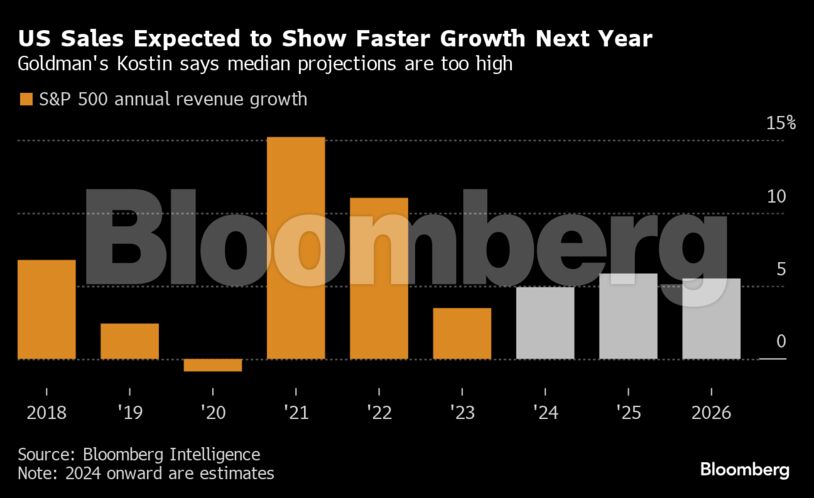
Corporate America’s expectations for sales next year are too high given the outlook for a moderating economy and weaker dollar, according to Goldman Sachs Group Inc. strategists.
The team led by David Kostin said it expects S&P 500 sales to rise by 4% in 2025 compared with 6% this year, as the median stock outside the energy sector is more sensitive to the economy and less international-facing.
By contrast, analysts expect a 5.8% increase in 2025 revenue, according to data compiled by Bloomberg Intelligence.
Corporate Highlights:
Key events this week:
Some of the main moves in markets:
Stocks
Currencies
Cryptocurrencies
Bonds
Commodities
This article is more than a year old
Newsdeck
Stocks ‘Climb Wall of Worry’ Before Jackson Hole: Markets Wrap
Stocks rose for an eighth straight day — the longest winning streak in 2024 — with traders hoping the Federal Reserve will signal it’s ready to start cutting rates.
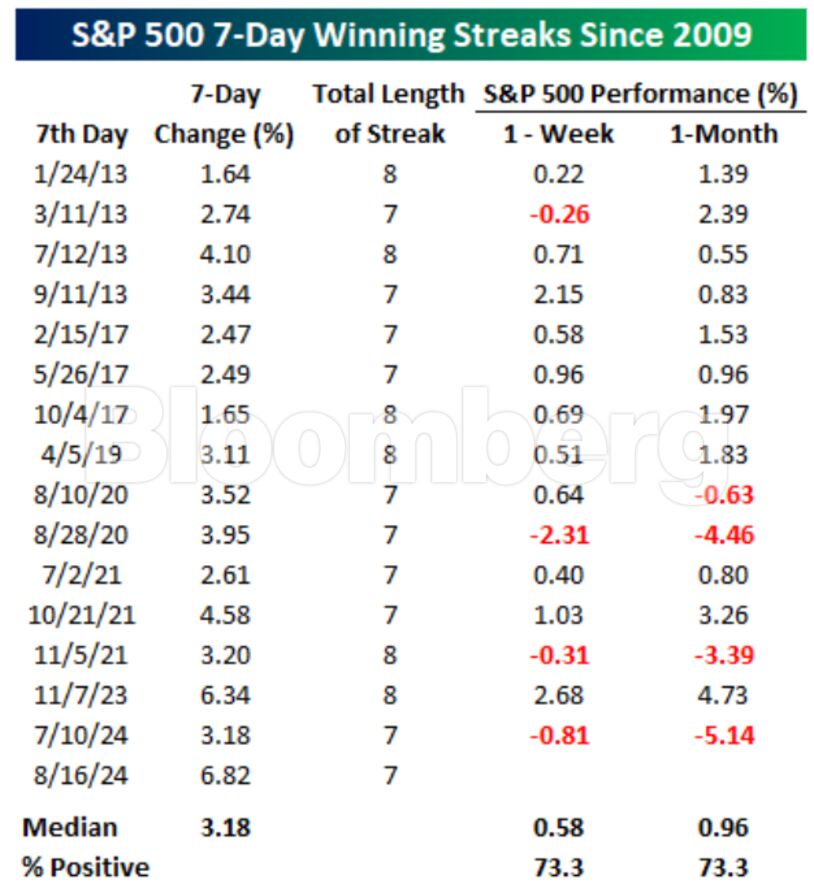
Source: Bespoke Investment Group
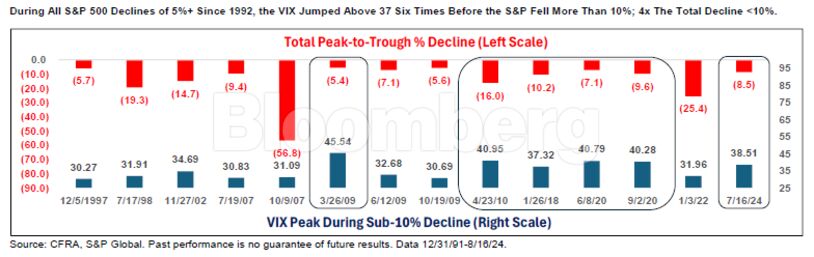
Source: CFRA
Comments
Scroll down to load comments...